Formulaire : Résumé Terminale S

Un résumé des notions fondamentales à connaître pour le Bac.

Complexes

M(x,y)M(x,y) dans (O;i⃗,j⃗)(O; \vec{i},\vec{j}) a pour affixe z:z=x+iyz : z = x + i y dans C\mathbb{C}

Le conjugué de z est : zˉ=x−iy\bar{z} = x - iy

Module de z:∣z∣=zzˉ=x2+y2z : |z| = \sqrt{z\bar{z}} = \sqrt{x^2 + y^2}

Forme trigonométrique : z=ρ(cos⁡θ+isin⁡θ)z = \rho(\cos \theta + i\sin \theta) où θ=angle(i⃗,OM→)[2π]\theta = angle (\vec{i}, \overrightarrow{OM}) [2\pi]

Forme exponentielle : z=ρeiθz = \rho e^{i\theta} (avec ∣z∣=ρ|z| = \rho et θ\theta = angle (i⃗,OM→)(\vec{i}, \overrightarrow{OM}) = argument de zz)

Conjugué de zz : zˉ=ρe−iθ\bar{z} = \rho e^{-i\theta}

Soient AA et BB d'affixes zAz_A zBz_B alors AB→\overrightarrow{AB} a pour affixe zB−zAz_B - z_A et AB=∣zB−zA∣AB = |z_B - z_A|

Propriétés des modules

∣zˉ∣=∣z∣|\bar{z}| = |z| ; ∣1z∣=1∣z∣\bigg|\dfrac{1}{z}\bigg| = \dfrac{1}{|z|} ; ∣zz′∣=∣z∣∣z′∣|zz'| = |z||z'|

Propriétés des arguments

arg⁡zz′=arg⁡z+arg⁡z′[2π]\arg{zz'}= \arg z + \arg z' [2\pi]

arg⁡(zz′)=arg⁡z−arg⁡z′[2π]\arg \bigg(\dfrac{z}{z'}\bigg) = \arg z - \arg z' [2\pi]

Transformations usuelles

Soit une transformation telle que M(z)→M′(z′)M(z) \rightarrow M'(z')

  • Translation de vecteur u⃗\vec{u} d'affixe t:z′=z+tt : z' = z + t

  • Homothétie de centre Ω\Omega d'affixe ω\omega et de rapport k:z′−ω=k(z−ω)k : z' - \omega = k (z- \omega)

  • Rotation de centre Ω\Omega d'affixe ω\omega et d'angle θ:z′−ω=eiθ(z−ω)\theta : z' - \omega = e^{i\theta} (z- \omega)

Equations du second degré dans C\mathbb{C}

Soit l'équation az2+bz+c=0az^2 + bz + c = 0 et le discriminant Δ=b2−4ac\Delta = b^2 - 4ac

  • si Δ>0\Delta > 0 alors 2 solutions réelles :

z1=−b+Δ2az_1 =\dfrac{-b +\sqrt{\Delta}}{2a} ; z2=−b−Δ2az_2 = \dfrac{-b -\sqrt{\Delta}}{2a}

et z1z2=caz_1z_2 = \dfrac{c}{a}; z1+z2=−baz_1 + z_2 =\dfrac{-b}{a}

  • si Δ=0\Delta = 0 alors 1 solution réelle : z0=−b2az_0 = \dfrac{-b}{2a}

  • si Δ<0\Delta < 0 alors 2 solutions complexes :

z1=−b+iΔ2az_1 =\dfrac{-b + i\sqrt{\Delta}}{2a}; z2=−b−iΔ2az_2 = \dfrac{-b - i\sqrt{\Delta}}{2a}

et z1z2=caz_1z_2 = \dfrac{c}{a}; z1+z2=−baz_1 + z_2 = \dfrac{-b}{a}

  • si Δ≠0\Delta \neq 0 alors az2+bz+c=a(z−z1)(z−z2)az^2 + bz + c = a(z - z_1) (z - z_2) et si Δ=0\Delta = 0 alors : az2+bz+c=a(z−z0)2az^2 + bz + c = a(z - z_0 )^2

Identités remarquables

(a+b)3=a3+3a2b+3ab2+b3(a + b)^3 = a^3 + 3a^2b + 3 ab^2 + b^3

a3+b3=(a+b)(a2−ab+b2)a^3 + b^3 = (a + b) (a^2 - ab + b^2 )

(a−b)3=a3−3a2b+3ab2−b3(a - b)^3 = a^3 - 3a^2b + 3 ab^2 - b^3

a3−b3=(a−b)(a2+ab+b2)a^3 - b^3 = (a - b) (a^2 + ab + b^2 )

(a+b)n=an+(n1)an−1b+...+(nk)an−kbk+....+(nn−1)abn−1+bn(a + b)^n = a^n + \begin{pmatrix} n \\ 1 \end{pmatrix} a^{n-1}b+ ... + \begin{pmatrix} n \\ k \end{pmatrix} a^{n-k}b^k + .... + \begin{pmatrix} n \\ n-1 \end{pmatrix} ab^{n-1}+b^n

Les suites

  • Suites arithmétiques de raison rr et premier terme u0u_0 Alors : un+1=un+ru_{n +1} = u_n + r ou un=u0+nru_n = u_0 + nr

  • Somme de nn termes consécutifs de la suite == "nbre de termes" • "1erterme"+"dernier"2\dfrac{"1^{er}terme" + "dernier"}{2}

En particulier : 1+2+3+.........+n=n(n+1)21+ 2 + 3+ .........+ n = \dfrac {n(n +1)}{2}

  • Suites géométriques de raison qq et premier terme u0u_0 alors un+1=q.unu_{n +1} = q.u_n ou un=u0qnu_n = u_0q^n

Somme de nn termes consécutifs de la suite = "1erterme""1^{er} terme" •
1−qnombredetermes1−q\dfrac{1- q^{nombre de termes}}{1- q} avec q≠1q \neq 1

En particulier : 1+x+x2+x3+.........+xn=1−xn+11−x1+ x + x^2 + x^3 + .........+ x^n = \dfrac{1- x^{n +1}}{1 - x} (x≠1)(x \neq 1)

Les fonctions logarithme et exponentielles

e0=1e^0 =1 ; ea+b=eaebe^{a +b} = e^ae^b ; ea−b=eaebe^{a-b} = \dfrac{e^a}{e^b} ; (ea)b=eab(e^a )^b = e^{ab} ; ln⁡e=1\ln{e} =1 ;

ln⁡1=0\ln{1}= 0 ; ln⁡ab=ln⁡a+ln⁡b\ln{ab} = \ln {a} + \ln{b} ;ln⁡ab=lna−lnb\ln{\dfrac{a}{b}}= ln{a} - ln{b}

ax=exln⁡aa^x = e^{x \ln{a}} ; ln⁡ax=xln⁡a\ln{a^x} = x \ln{a} ; y=ex⟺x=ln⁡yy= e^x \Longleftrightarrow x = \ln{y}

Les limites usuelles de fonctions

lim⁡x→+∞ln⁡x\lim\limits_{x \rightarrow +\infty} \ln{x} =+∞= +\infty

lim⁡x→+∞ex\lim\limits_{x \rightarrow +\infty} e^x =+∞= +\infty

lim⁡x→−∞ex\lim\limits_{x \rightarrow -\infty} e^x =0= 0

lim⁡x→+∞exx\lim\limits_{x \rightarrow +\infty} \dfrac{e^x}{x} =+∞= +\infty

lim⁡x→−∞xex\lim\limits_{x \rightarrow -\infty} xe^x =0= 0

lim⁡x→+∞ln⁡xx\lim\limits_{x \rightarrow +\infty} \dfrac{\ln{x}}{x} =0= 0

lim⁡x→+∞exxn\lim\limits_{x \rightarrow +\infty} \dfrac{e^x}{x^n} =+∞= +\infty

lim⁡x→+∞ln⁡xxn\lim\limits_{x \rightarrow +\infty} \dfrac{\ln{x}}{x^n} =0= 0

lim⁡x→−∞xnex\lim\limits_{x \rightarrow -\infty} x^ne^x =0= 0

lim⁡x→+∞xne−x\lim\limits_{x \rightarrow +\infty} x^ne^{-x} =0= 0

lim⁡x→0ln⁡x\lim\limits_{x \rightarrow 0} \ln{x} =−∞= -\infty

lim⁡x→0xln⁡x\lim\limits_{x \rightarrow 0} x\ln{x} =0= 0

lim⁡x→0sin⁡xx\lim\limits_{x \rightarrow 0} \dfrac{\sin{x}}{x} =1= 1

lim⁡x→01−cos⁡xx\lim\limits_{x \rightarrow 0} \dfrac{1-\cos{x}}{x} =0= 0

lim⁡x→0ln⁡1+xx\lim\limits_{x \rightarrow 0} \dfrac{\ln{1+ x}}{x} =1= 1

lim⁡x→0ex−1x\lim\limits_{x \rightarrow 0} \dfrac{e^x -1}{x} =1= 1

Les dérivées primitives

f(x)f(x) f′(x)f'(x)
kk 00
1x\dfrac{1}{x} −1x2\dfrac{-1}{x^2}
ln⁡x\ln{x} 1x\dfrac{1}{x}
cos⁡x\cos{x} −sin⁡x-\sin x
xx 11
1xn\dfrac{1}{x^n} n∈Nn \in \mathbb{N} −nxn+1\dfrac{-n}{x^{n+1}}
exe^x exe^x
sin⁡x\sin{x} cos⁡x\cos x
xnx^n nxn−1nx^{n-1}
x\sqrt{x} 12x\dfrac{1}{2\sqrt{x}}
axa^x axln⁡aa^x \ln{a}
tan⁡x\tan{x} 1cos⁡2x\dfrac{1}{\cos^2{x}}

Opérations et application des dérivées

(u+v)′=u′+v′( u + v)' = u' + v' (ku)′=ku′(k u)' = k u'
(uv)′=u′v+uv′(u v)' = u' v + u v' (1u)′=−u′u2\bigg(\dfrac{1}{u}\bigg)' = \dfrac{-u'}{u^2}
(u′)′=u′2u\big(\sqrt{u'}\big)'= \dfrac{u'}{2\sqrt{u}} (un)′=nu′un−1(u^n)'= nu'u^{n-1}
(uv)′=u′v−uv′v2\bigg(\dfrac{u}{v}\bigg)' = \dfrac{u'v -uv'}{v^2} (v∘u)′=u′.v∘u(v \circ u)' = u'.v \circ u
(eu)′=u′eu(e^u)'=u'e^u ln⁡u′=uu′\ln{u}' =\dfrac{u}{u'}
  • Equation de la tangente à la courbe CfCf en A(a;f(a)):y=f′(a)(x−a)+f(a)A(a; f (a)) : y = f '(a) (x - a) + f (a)

Calcul intégral - Les équations différentielles

Si FF primitive ce ff alors :

∫abf(t)dt=F(b)−F(a)\int_{a}^{b} f(t)dt = F(b)-F(a) et si g(x)=∫axf(t)dtg(x)=\int_{a}^{x} f(t)dt alors g′(x)=f(x)g'(x)=f(x)

∫abf(t)dt=−∫baf(t)dt\int_{a}^{b} f(t)dt = -\int_{b}^{a} f(t)dt

∫acf(t)dt=∫abf(t)dt+∫bcf(t)dt\int_{a}^{c} f(t)dt = \int_{a}^{b} f(t)dt + \int_{b}^{c} f(t)dt

∫abf(t)dt=α∫abf(t)dt+β∫bag(t)dt\int_{a}^{b} f(t)dt = \alpha \int_{a}^{b} f(t)dt + \beta\int_{b}^{a} g(t)dt

si a⩽ba \leqslant b et f⩾0f \geqslant 0 alors

∫abf(t)dt⩾0\int_{a}^{b} f(t)dt \geqslant 0 ; si a⩽ba \leqslant b et f⩽gf \leqslant g alors a∫abf(t)dt⩽∫abg(t)dta \int_{a}^{b} f(t)dt \leqslant \int_{a}^{b} g(t)dt

si a⩽ba \leqslant b et m⩽f⩽Mm \leqslant f \leqslant M alors m(b−a)⩽∫abf(t)dt⩽M(b−a)m(b - a) \leqslant \int_{a}^{b} f(t)dt \leqslant M(b-a)

Intégration par parties

∫abu(t)v′(t)dt=[u(t)v(t)]ab−∫abu′(t)v(t)dt\int_{a}^{b} u(t)v'(t) d_t= \bigg[u(t)v(t)\bigg]_{a}^{b} - \int_{a}^{b} u'(t)v(t) d_t

Equations différentielles

Les solutions de y′=ay+by'= ay + b sont des fonctions f(x)=Ceax−baf (x) = Ce^{ax} - \dfrac{b}{a} où CC est un réel.

Les Probabilités

Dénombrements

n!=1×2×3×…×nn! = 1 \times 2 \times 3 \times … \times n avec 0!=10! = 1 et (n+1)!=n!×(n+1)(n+1)! = n! \times (n+1).

Le nombre de combinaisons de pp éléments pris parmi nn est noté (np)\begin{pmatrix} n \\ p \end{pmatrix}

(np)=n(n−1)...(n−p+1)p!=n!p!(n−p)!\begin{pmatrix} n \\ p \end{pmatrix} = \dfrac{n(n-1)...(n-p+1)}{p!} = \dfrac{n!}{p!(n-p)!} ; (np)=(nn−p)\begin{pmatrix} n \\ p \end{pmatrix} = \begin{pmatrix} n \\ n-p \end{pmatrix} ; (np)=(n−1n−p)+(n−1p)\begin{pmatrix} n \\ p \end{pmatrix} = \begin{pmatrix} n-1 \\ n-p \end{pmatrix} + \begin{pmatrix} n-1 \\ p \end{pmatrix} ; (n1)=n\begin{pmatrix} n \\ 1 \end{pmatrix} = n

Développement

(a+b)n=an+(n1)an−1b+...+(nk)an−kbk+...+bn(a+b)^n = a^n + \begin{pmatrix} n \\ 1 \end{pmatrix}a^{n-1}b+...+ \begin{pmatrix} n \\ k \end{pmatrix}a^{n-k}b^{k}+...+b^n

Généralités :

P(A∪B)=P(A)+P(B)−P(A∩B)P(A \cup B) = P(A) + P(B) - P(A \cap B) ; P(Aˉ)=1−P(A)P(\bar{A}) =1- P(A) ; P(Ω)=1P(\Omega) =1 ; P(⊘)=0P( \oslash) = 0

En cas d'équiprobabilité :
P(A)=nombred′eˊleˊmentsdeAnombred′eˊleˊmentsdeΩP(A) = \dfrac{nombre d'éléments de A}{nombre d'éléments de \Omega} = "nombredecasfavorables""nombredecaspossibles"\dfrac{"nombre de cas favorables"}{"nombre de cas possibles"}

Proba de BB sachant AA :PA(B)=P(A∩B)P(A)P_A (B) = \dfrac{P(A \cap B)}{P(A)}; si AA et BB sont indépendants P(A∩B)=P(A)×P(B)P(A \cap B) = P(A) \times P(B)

Trigonométrie - Produit scalaire

Formules d'addition

  • cos⁡(a+b)=cos⁡acos⁡b−sin⁡asin⁡b\cos{(a+b)} = \cos {a} \cos{b} - \sin{a} \sin{b}

  • cos⁡(a−b)=cos⁡acos⁡b+sin⁡asin⁡b\cos{(a-b)} = \cos{a} \cos{b} + \sin{a} \sin{b}

  • sin⁡(a+b)=sin⁡acos⁡b+cos⁡asin⁡b\sin {(a+b)} = \sin{a} \cos{b} + \cos{a} \sin{b}

  • sin⁡(a−b)=sin⁡acos⁡b−cos⁡asin⁡b\sin{(a-b)} = \sin{a} \cos{b} - \cos{a} \sin{b}

Formules de duplication

cos⁡(2a)=cos⁡2a−sin⁡2a=2cos⁡2a−1=1−2sin⁡2a\cos(2a) = \cos^2{a} - \sin^2{a} = 2\cos^2{a}-1 = 1 - 2\sin^2 {a}

sin⁡(2a)=2sin⁡acos⁡a\sin{(2a)} = 2\sin{a}\cos{a}

Valeurs remarquables

00 π6\dfrac{\pi}{6} π4\dfrac{\pi}{4} π3\dfrac{\pi}{3} π2\dfrac{\pi}{2} π\pi
sin⁡\sin 00 12\dfrac{1}{2} 22\dfrac{\sqrt {2}}{2} 32\dfrac{\sqrt {3}}{2} 11 00
cos⁡\cos 11 32\dfrac{\sqrt{3}}{2} 22\dfrac{\sqrt {2}}{2} 12\dfrac{1}{2} 00 −1-1
tan⁡\tan 00 33\dfrac{\sqrt{3}}{3} 11 3\sqrt{3} n'existe pas 00

Produit scalaire

u⃗\vec{u} et v⃗\vec{v} tels que u⃗=OA→\vec{u} = \overrightarrow{OA} ; v⃗=OB→\vec{v} = \overrightarrow{OB} ; soit θ=angle(OA→,OB→)\theta = angle (\overrightarrow{OA},\overrightarrow{OB}) alors
u⃗∙v⃗=OA→∙OB→=OA×OB×cosθ\vec{u} \bullet \vec{v} = \overrightarrow{OA} \bullet \overrightarrow{OB} = OA \times OB \times cos \theta

si u⃗(x;y)\vec{u}(x;y) et v⃗(x′;y′)\vec{v}(x';y') alors u⃗∙v⃗=xx′+yy′\vec{u} \bullet \vec{v} = xx'+yy'

si OB→\overrightarrow{OB} se projette en OH→\overrightarrow{OH} sur OA→\overrightarrow{OA} alors

  • u⃗∙v⃗=OA×OH\vec{u} \bullet \vec{v} = OA \times OH (si les vecteurs sont de même sens)
  • u⃗∙v⃗=−OA×OH\vec{u} \bullet \vec{v} = -OA \times OH (si sens contraires)

u⃗\vec{u} et v⃗\vec{v} sont orthogonaux u⃗∙v⃗=0\vec{u} \bullet \vec{v} = 0

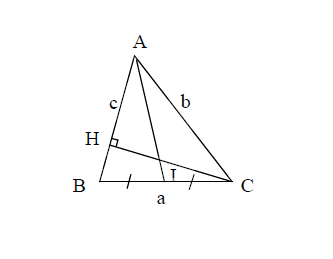
Al Khashi :

a2=b2+c2−2bccos⁡A^a^2 = b^2 + c^2 - 2bc \cos{\widehat{A}}

Théorème de la médiane :

c2+b2=2AI2+a22c^2 + b^2 = 2AI^2 + \dfrac{a^2}{2}

Aire du triangle :

S=12bcsin⁡A^S =\dfrac{1}{2}bc \sin{\widehat{A}}

Formule des sinus :

asin⁡A^=bsin⁡B^=csin⁡C^\dfrac{a}{\sin{\widehat{A}}}=\dfrac{b}{\sin{\widehat{B}}}=\dfrac{c}{\sin{\widehat{C}}}

Equation de droite :

ax+by+c=0ax + by + c = 0 équation de DD qui admet pour vecteur directeur u⃗(−b;a)\vec{u} (-b;a) et normal ("⊥\perp") v⃗(a;b)\vec{v} (a;b).

image

Toutes nos vidéos sur les notions à connaître absolument pour le bac s


Posez vos questions

D'autres interrogations sur ce cours ? Démarrez une discussion et obtenez des réponses à des exercices pratiques.

Accéder au forum